Testing basics
Psychoeducational vs. neuropsychological evaluation: what's the difference?
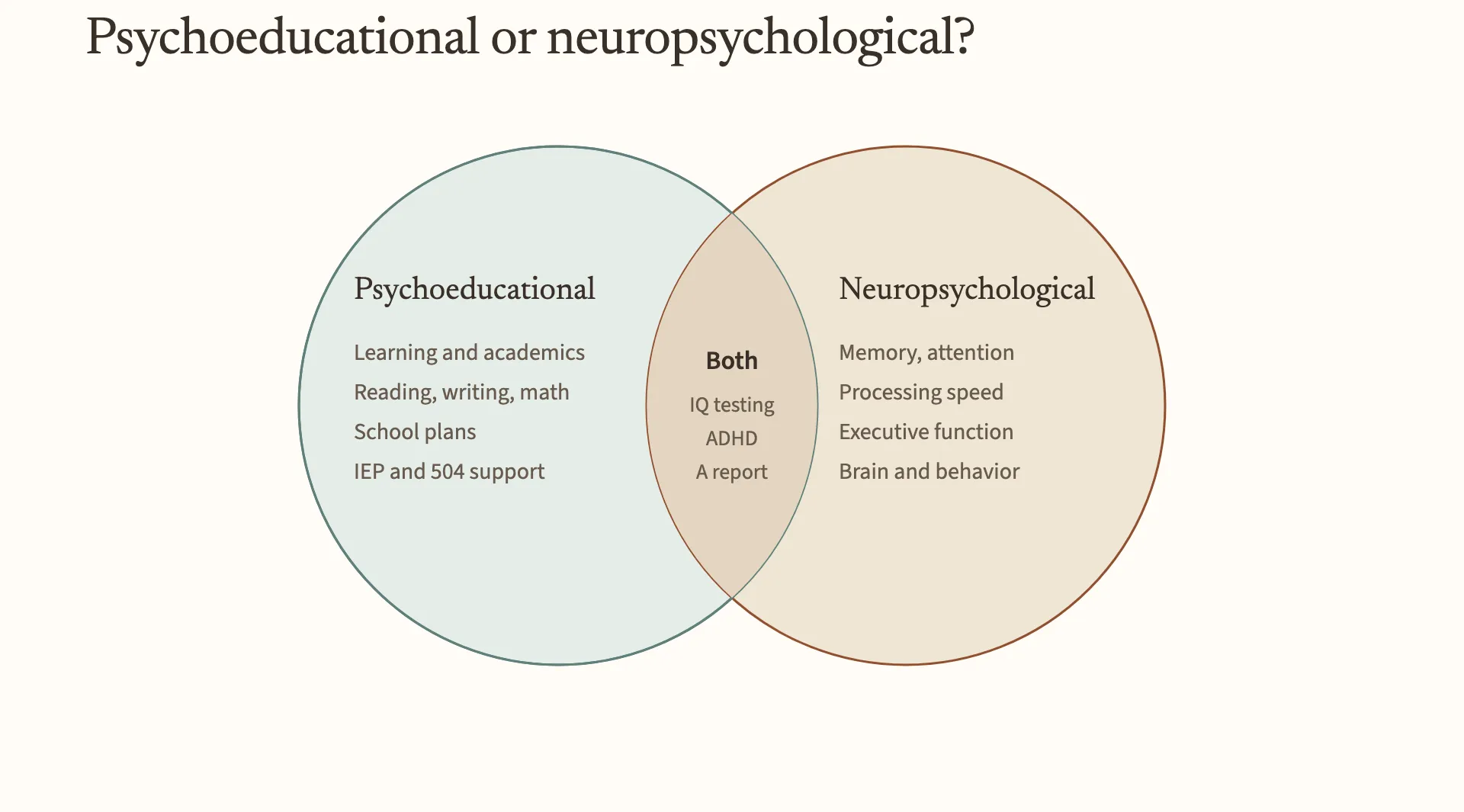
A psychoeducational evaluation focuses on learning: thinking skills, reading, writing, math and what a child needs at school. A neuropsychological evaluation covers much of the same ground, then looks more closely at memory, attention, processing speed and executive function, often when there is a medical or brain-related question. The two terms overlap, and clinicians use them differently.
What is the difference between a psychoeducational and a neuropsychological evaluation?
The short answer is scope. A psychoeducational evaluation asks how a child learns and what they need at school. A neuropsychological evaluation asks a wider question: how the brain is working across many skills, and how that shows up in daily life.
In practice, the two often look alike. Both usually include tests of thinking skills, academic skills, attention and emotional health. Both end with a written report. The difference is mostly in how deep the testing goes in certain areas, and in the reason for the evaluation in the first place.
It also helps to know that there is no single, official definition of either term. One clinician’s “psychoeducational evaluation” may include more than another clinician’s “neuropsychological evaluation.” So the label on the evaluation matters less than the questions it is built to answer. When you talk with any evaluator, ask what they will test and why.
What does a psychoeducational evaluation look at?
A psychoeducational evaluation starts with learning. It usually covers:
- Thinking skills: reasoning, language, visual-spatial skills, working memory (holding information in mind while using it) and processing speed
- Academic skills: reading, writing, spelling and math, compared with what is expected for your child’s age or grade
- Attention and behavior: often through rating scales filled out by parents and teachers
- Emotional factors: anxiety, mood and how your child sees themselves as a learner
This kind of evaluation fits questions like “Why is reading so hard for my child?” or “Does my child have a learning disability?” It can show whether your child meets criteria for a specific learning disorder, such as dyslexia (reading), dysgraphia (writing) or dyscalculia (math). It can also help answer ADHD questions.
The recommendations tend to be practical and school-focused. Think classroom accommodations, reading support, test-taking changes and ideas for an IEP or 504 plan. Learn more on our psychoeducational evaluation page.
What does a neuropsychological evaluation look at?
A neuropsychological evaluation includes most of the same areas. It then adds more depth in skills tied to how the brain processes information:
- Memory: learning new information, holding onto it and recalling it later, for both words and pictures
- Attention: focusing, staying focused, and shifting between tasks
- Executive function: planning, organizing, starting and finishing tasks, and controlling impulses
- Processing speed: how quickly and accurately a child takes in and responds to information
- Language, visual-spatial and motor skills: sometimes including fine-motor coordination
This deeper look is most useful when the question goes beyond school. Examples include a history of concussion or other head injury, epilepsy, a genetic condition, premature birth, or a medical treatment that can affect thinking. It can also help when a child’s profile is complex, such as when ADHD, autism, anxiety and a learning disability may all be part of the picture.
Learn more on our neuropsychological evaluation page.
How do the two compare side by side?
Here is a general comparison. Keep in mind that individual clinicians and clinics draw these lines in different places.
| Question | Psychoeducational evaluation | Neuropsychological evaluation |
|---|---|---|
| Focus | Learning, academic skills and school needs | How thinking skills work together, across school and daily life |
| Typical questions | “Does my child have dyslexia?” “Why are grades slipping?” “Is it ADHD?” | “How did a concussion affect my child?” “Why is everything so hard when testing looks fine?” “What explains this complex picture?” |
| What’s tested | Thinking skills, reading, writing, math, attention, emotional health | All of that, plus more detail on memory, attention, executive function, processing speed, and sometimes motor skills |
| Who usually does it | A licensed psychologist, or a school psychologist when done through the school | A licensed psychologist with training in neuropsychological assessment, often called a neuropsychologist |
| What you get | A written report, diagnosis when one fits, and school and home recommendations | A written report, diagnosis when one fits, and recommendations that may also reach medical care and daily routines |
| When to choose it | Your main questions are about learning and school | There is a medical or brain-related history, or the picture is complex |
Costs vary between practices and between types of evaluation. Our fees and insurance page explains what our evaluations cost and what they include.
Who does each kind of evaluation?
In California, psychologists are licensed as psychologists. There is no separate state license for a “neuropsychologist.” The title usually means a psychologist with extra training in brain-behavior relationships. Some also hold board certification in neuropsychology.
School psychologists also do psychoeducational testing through public schools. That testing decides whether a child qualifies for special education or a 504 plan. It is free, and it is valuable. It usually does not lead to a medical diagnosis, though. For more on how school and private testing fit together, read school testing vs. private evaluation.
At MP Wellness, Dr. Maddison Paul is a licensed clinical psychologist. Her postdoctoral training focused on psychological and neuropsychological assessment. She offers both kinds of evaluation in our Hermosa Beach office and shapes each one around your questions.
Does a neuropsychological evaluation mean something is “more wrong”?
No. Choosing a neuropsychological evaluation does not mean your child’s concerns are more serious. It means the questions call for a closer look at certain skills.
Likewise, a psychoeducational evaluation is not a “lighter” version. For most learning and attention questions, it is the right fit. Testing more areas than needed adds time without adding useful answers.
How do you choose the right evaluation for your child?
Start with your questions, not the label. Write down what you are seeing and what you want to understand. Then ask these:
- Is the concern mostly about learning? Trouble with reading, spelling, writing or math often points to a psychoeducational evaluation.
- Is there a medical history? A head injury, seizures, a genetic condition, early birth or treatment that can affect the brain may point to a neuropsychological evaluation.
- Are there several overlapping concerns? When attention, learning, mood and social skills all seem involved, a broader evaluation can help sort them out.
- What will you do with the results? If you mainly need school support, a psychoeducational evaluation often gives you what you need. If a doctor has asked for testing, ask what they hope to learn.
- Has your child had testing before? Past results can help focus the new evaluation, so nothing is repeated without a reason.
You do not need to figure this out alone. A good evaluator will ask about your concerns first and then suggest the evaluation that fits. If the questions change once testing begins, the plan can change too.
What happens in either evaluation?
The steps are similar for both. Most evaluations include:
- A consultation to talk about your concerns and decide which evaluation fits
- An intake meeting about your child’s development, health, school history and family background
- Testing sessions where your child works one-on-one with the psychologist, with breaks
- Rating scales from you and, often, your child’s teachers
- A feedback session where we explain the results and recommendations, and you receive the written report
For details on our process, see our assessments page. If your child is nervous about testing, our guide to preparing your child for testing day may help.
When to reach out
If you are not sure which evaluation your child needs, that is a good reason to call. We will talk through your concerns and help you decide. Read more about our psychoeducational evaluation, or contact us to set up a consultation. We see families from Redondo Beach, Manhattan Beach, Torrance and across the South Bay.
About the author
Licensed Clinical Psychologist
- California license PSY 36605 · Verify with the state (opens the California DCA license search)
- Doctoral training in clinical psychology
- About about eight years of psychological and neuropsychological assessment experience
- Born and raised in Redondo Beach
This article is general information, not a diagnosis or medical advice. Every child is different. If you have concerns, talk with your pediatrician or a licensed psychologist.